

How to Increase Average Order Value — Immediate Profit Growth Without Extra Customers
By Zion Hospitality · Chef Ajay Chopra
Every restaurant owner understands the pressure of needing more customers. More footfall, more covers, more bookings — the instinct when revenue is under pressure is always to focus on the top of the funnel. Get more people through the door. Spend more on marketing. Run more promotions. Acquire more guests.
What most restaurant owners dramatically underestimate is the power of the alternative: selling more to the guests who are already sitting in front of you.
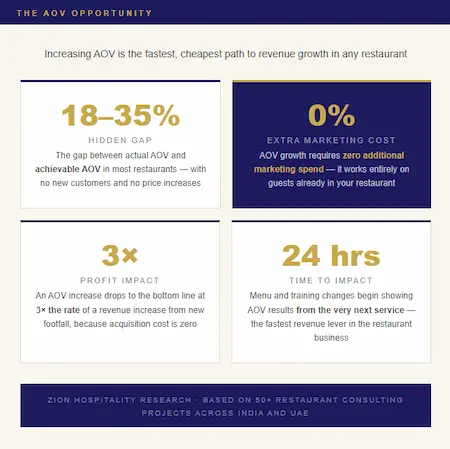
Average Order Value — or AOV — is the average amount each guest or table spends per visit. It is one of the three fundamental levers of restaurant revenue, alongside footfall and visit frequency. And of the three, it is the fastest to move, the cheapest to improve, and the most immediately impactful on your bottom line. A 20% increase in AOV with the same number of covers produces the same revenue result as a 20% increase in footfall — but without the marketing cost, the operational strain, or the time lag.
At Zion Hospitality by Chef Ajay Chopra, AOV optimisation is one of the first things we address in every consulting engagement. In most restaurants, the gap between actual AOV and achievable AOV — with no additional customers and no price increases — is between 18% and 35%. That gap represents pure, accessible profit that most operators are leaving on the table every single service.
This guide covers every lever available to you: menu engineering, pricing psychology, beverage revenue, upselling technique, bundling strategy, and the team training that makes all of it work in practice.
What this guide will help you achieve:
-
Understand exactly why your current AOV is lower than it should be
-
Apply menu engineering principles to make higher-value choices feel natural to your guests
-
Build a beverage, starter, and dessert strategy that adds meaningfully to every bill
-
Train your team to upsell with warmth and expertise rather than pressure
-
Use pricing psychology to anchor guest decisions toward your most profitable items
-
Measure, track, and systematically grow your AOV over time
Part One: Menu Engineering — The Architecture of Higher Spend
Your menu is not a list of dishes. It is a sales document. Every decision about layout, typography, item placement, description, and pricing directly influences what your guests order — and therefore what they spend. Menu engineering is the discipline of designing that sales document with deliberate intent, so that guests are guided naturally toward the choices that are best for them and most profitable for you.
The concept of menu engineering was developed in the 1980s and has been refined extensively through decades of hospitality research. The core finding is consistent and powerful: guests do not read menus linearly. They scan. They are influenced by visual hierarchy, by the placement of high-price items, by description length, by the strategic absence of currency symbols, and by what appears to be the most popular or most recommended option. Understanding these patterns allows you to design a menu that increases average order value without raising a single price.
In our consulting experience, poorly engineered menus are the single most common cause of low AOV in otherwise well-run restaurants. The kitchen is producing excellent food. The service team is engaged. The pricing is appropriate. But the menu is presenting everything with equal weight — 80 items in identical font, no hierarchy, no guidance, no narrative — and guests are defaulting to the first familiar item they recognise rather than exploring and ordering more.
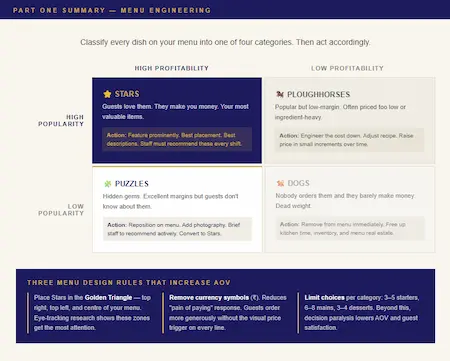
The Four Menu Engineering Categories
Menu engineering begins with classifying every item on your menu into one of four categories based on two variables: popularity (how often it is ordered) and profitability (how much gross profit it generates).
-
Stars — High Popularity, High Profitability: Your stars are the items that guests love and that make you money. These are your most important items. They should be featured prominently, described with the most compelling language, and supported visually. Your sales objective for stars is to ensure every guest is aware of them and that your team recommends them enthusiastically.
-
Ploughhorses — High Popularity, Low Profitability: These are the items guests order frequently but that generate low margins — often because of high ingredient costs or because they were priced too aggressively in the past. Your objective here is to either engineer the cost down (adjust the recipe, change portion ratios) or gradually move the price up in increments small enough to avoid resistance.
-
Puzzles — Low Popularity, High Profitability: These are your hidden gems — dishes with excellent margins that guests simply are not ordering, often because they are not being highlighted or recommended. Your objective is to promote these items through menu placement, photography, and staff recommendation. Converting a puzzle into a star is one of the highest-leverage actions in menu engineering.
-
Dogs — Low Popularity, Low Profitability: Items that neither guests want nor make you money. Your objective here is straightforward: remove them. Every dog on your menu is consuming kitchen time, ingredient inventory, and menu real estate that could be given to a star or a puzzle. Smaller, more focused menus consistently outperform large menus on both guest satisfaction and AOV.
The Golden Triangle — Where Guest Eyes Go First
Research using eye-tracking technology on restaurant menus has consistently identified what is known as the "Golden Triangle" — the three areas of a menu page that receive the most attention from scanning guests. For a standard single-page or two-page menu, these areas are: the top right of the right-hand page (where the eye naturally lands first), the top of the left-hand page, and the centre of the menu.
Items placed in the Golden Triangle receive significantly more orders than items of similar quality and price placed elsewhere. This is not because guests consciously prefer them — it is because they are the first items a scanning guest encounters, and first-encountered options carry a disproportionate share of the ordering decision. Position your Stars and your highest-margin Puzzles in these three zones. Reserve the bottom of left-hand pages and the bottom of right-hand pages for your lower-priority items.
Descriptions That Sell — The Language of Appetite
Menu descriptions are among the most underinvested elements in restaurant operations. Most menus list ingredients. The best menus tell stories. Research by Dr. Brian Wansink at Cornell University demonstrated that descriptive menu labels — "Slow-Braised Tender Lamb Shoulder with Roasted Garlic Jus" versus simply "Lamb" — increased sales of those items by 27% and increased guest satisfaction scores for the same dish. The dish did not change. The words around it did.
Good menu descriptions do three things: they evoke a sensory experience (taste, texture, aroma), they signal quality through specific rather than generic language, and they create anticipation. "Crispy" is better than "fried." "Wild-caught" is better than "fresh." "House-made" is better than "homemade." "Slow-cooked for six hours" is better than "slow-cooked." Specificity signals craft, and craft signals value.
Removing Currency Symbols — A Small Change With Measurable Impact
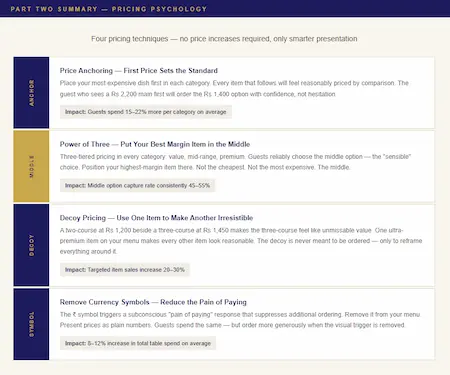
Multiple studies on menu psychology have demonstrated that the mere presence of a currency symbol (₹) next to a price activates a "pain of paying" response in guests — a subtle psychological discomfort that makes them more reluctant to order additional items. Removing the currency symbol, or presenting prices in a text format rather than a numerical one, reduces this pain response and consistently increases average spend.
This is not manipulation — it is design. Your guests are not unaware of what they are paying. They simply make more relaxed, more generous ordering decisions when the visual trigger of the price tag is softened. Test this change on your next menu iteration and measure the AOV difference over four weeks.
Menu Length and Cognitive Overload
The paradox of choice is well-documented in consumer psychology: beyond a certain number of options, additional choices reduce satisfaction and reduce purchasing confidence. For restaurants, the practical implication is that menus with fewer, better-described items consistently produce higher average order values than long menus with many undescribed items.
The optimal number of items per category in a restaurant menu varies by format, but as a general guideline: three to five appetisers, six to eight mains, three to four desserts. Menus beyond these counts begin to generate decision paralysis — guests spend more time deciding and ultimately order the most familiar, lowest-risk option rather than exploring. Every dish you remove from your menu in favour of better describing and positioning what remains is likely to increase both AOV and kitchen efficiency simultaneously.
Part Two: Pricing Psychology — How Price Presentation Shapes What People Spend
Price psychology is one of the most rigorously studied areas in consumer behaviour, and its applications in the restaurant context are both powerful and underutilised. The way prices are displayed, compared, and contextualised has a direct and measurable effect on what guests choose and what they spend — independent of the actual prices themselves.
Understanding and applying these principles does not require raising your prices. It requires designing the way your current prices are presented so that guests naturally gravitate toward mid-to-high-value choices rather than defaulting to the lowest price point on the menu. This is not manipulation — it is the same design intelligence that the world's best hospitality brands apply in every market.
Price Anchoring — Setting the Reference Point
Price anchoring is the single most powerful and most broadly applicable pricing psychology principle for restaurants. The concept is simple: when people evaluate whether a price is reasonable, they do not make an absolute judgement — they make a relative one. They compare the price in question to a reference point, or "anchor," that was presented earlier.
In a restaurant context, this means that the first price a guest encounters on your menu sets the anchor for everything that follows. If the first item they see is priced at Rs 1,800, the Rs 900 dish that appears next feels like excellent value. If the first item they see is priced at Rs 400, the Rs 900 dish feels expensive. The dishes are identical. The prices are identical. The anchor is everything.
The practical application: place your most expensive dish — not necessarily your most popular one — in the first visible position of each category. This does not mean guests will order that dish. It means every other dish in the category will feel reasonably priced by comparison. The guest who sees a Rs 2,200 lamb rack first will order the Rs 1,400 lamb curry with confidence and a sense of value. The guest who sees the Rs 650 dal first will perceive the Rs 1,400 lamb curry as expensive.
The Power of Three — Tiered Pricing Within Categories
Behavioural economics research consistently shows that when offered three options at different price points, most people choose the middle option. This is sometimes called the "compromise effect" — the middle option feels like the sensible, balanced choice. It avoids the perceived extravagance of the most expensive option and the perceived inadequacy of the cheapest.
For restaurants, this means designing your menu categories in groups of three where possible: a value option, a mid-range option, and a premium option. Position your highest-margin item as the middle option. Not the cheapest — that signals compromise. Not the most expensive — that signals indulgence. The middle option signals wisdom. And it will be ordered more than either alternative.
Apply this to your beverage list as well. Three wine options at Rs 500, Rs 850, and Rs 1,400 per glass will produce consistently higher average wine spend than two options at Rs 500 and Rs 1,400 — because the Rs 850 middle option gives guests a comfortable, socially safe choice that they would not have made in a two-option world.
Decoy Pricing — Using One Item to Sell Another
A decoy is a menu item that is not intended to be ordered frequently — it is intended to make another item look more attractive by comparison. The classic restaurant example is a prix-fixe menu: offering a two-course menu at Rs 1,200 and a three-course menu at Rs 1,450 makes the three-course option feel like extraordinary value — even if the restaurant's preferred outcome was always to sell the three-course. The two-course menu is the decoy. Its purpose is to make the Rs 1,450 look like an easy, obvious decision.
Decoy pricing can also be applied at the item level. Including a single extremely premium version of a dish — "Wagyu Beef Burger at Rs 2,800" on a menu where all other burgers are Rs 650 to Rs 900 — makes all the other burgers look reasonably priced and, critically, makes guests feel like the Rs 900 option is a generous, premium choice rather than the most expensive thing on offer.
Rounding and Price Point Psychology
Research on restaurant price points is nuanced but consistent in one finding: prices ending in 9 (Rs 299, Rs 599) are associated with budget establishments and value positioning. If you are operating in a mid-range or premium casual format, these price endings subtly undercut your positioning. Rounded prices (Rs 300, Rs 600) or prices ending in 5 (Rs 295, Rs 575) communicate quality and confidence rather than discount hunting. Audit your price points for internal consistency with your positioning — small adjustments can significantly affect brand perception.
Part Three: Beverage Revenue — The Biggest Missed AOV Opportunity in Indian Restaurants
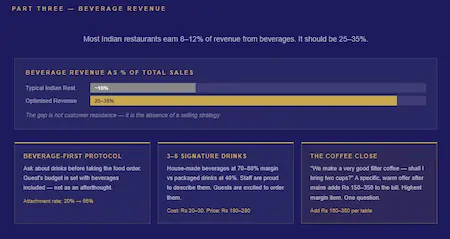
If there is one consistent finding across every restaurant consulting engagement we undertake, it is this: beverage revenue is the most underperformed category in Indian F&B, and it represents the single largest accessible AOV opportunity for most operators. In a well-run restaurant where beverages are actively sold, drinks can account for 25 to 35 percent of total revenue. In the average Indian restaurant we consult on, that figure is closer to 8 to 12 percent. The gap is staggering — and almost entirely attributable to the absence of a beverage selling strategy, not to a lack of guest interest.
Guests do not resist beverages. They are not typically opposed to ordering a mocktail, a fresh juice, a lassi, a wine, or a coffee. What they resist — or more accurately, what they never encounter — is a confident, compelling invitation to do so. In most Indian restaurants, the beverage offering is presented as an afterthought: a laminated insert tucked behind the food menu, mentioned apologetically after the food order has been placed, or not mentioned at all. The guest's mental budget for the meal has already been established around food alone, and the beverage category never gets a fair hearing.
The Beverage-First Protocol
The single most impactful change most restaurants can make to their beverage revenue is what we call the Beverage-First Protocol: present your beverage offering — verbally and through the menu — before the food order is taken. Not after. Not simultaneously. Before.
The psychological reason is straightforward: when a guest places their food order, their mental spending budget for the meal is largely set. The mains are chosen. The starters are decided. Adding a beverage on top of this figure feels like an increment to a completed decision. But when the beverage conversation happens first — "Would you like to start with something to drink while you look at the menu?" — it is part of the initial ordering decision, not an add-on. The guest's mental budget is set with beverages included from the start.
This one protocol change — asking about beverages before taking the food order — can increase beverage attachment rates from 20 to 30 percent (typical for reactive ordering) to 60 to 70 percent (typical for proactive, pre-food-order asking). The improvement in per-table beverage revenue is immediate and consistent.
Building a Beverage Programme That Sells Itself
Beyond the protocol, the beverage programme itself needs to be worthy of selling. A poorly designed, generic beverage list — three lassis, four soft drinks, and a packaged juice selection — does not give your team anything compelling to recommend. The investment in developing three to five signature house beverages — a house lemonade with a house-made syrup, a signature mocktail using seasonal ingredients, a house-blended masala chai with a recognisable ritual — creates conversation starters that staff are proud to describe and guests are excited to order.
Signature beverages also carry significantly higher margins than standard items. A house-made rose and litchi soda that costs Rs 25 to produce and is priced at Rs 200 is a far better margin contribution than a packaged soft drink at Rs 40 cost and Rs 80 selling price. The signature beverage is also an Instagram moment, a word-of-mouth driver, and a point of differentiation — a packaged soft drink is none of these things.
The Coffee and Tea Close — Extending the Bill
One of the most consistent AOV improvements we see across every restaurant format is the active sale of post-meal coffee or tea. Most restaurants ask — briefly and easily dismissibly — "Would you like any coffee or tea?" after the main course. The ask is made as a question expecting a polite "no thank you." The guest picks up on this energy and declines.
The high-converting alternative is a specific, warm offer: "We make a very good single-origin South Indian filter coffee — can I get one for the table?" or "Our masala chai is house-blended and spiced — it's a nice way to finish. Shall I bring two cups?" The specificity, the warmth, and the implicit assumption that the answer will be positive produces a dramatically higher acceptance rate. Post-meal beverages typically carry the highest margins on your entire menu. They extend the table occupancy slightly — which is operationally acceptable in most scenarios — and they consistently add Rs 150 to Rs 350 to the average bill with a single well-placed question.
Alcohol and Premium Beverage Revenue
For restaurants with a liquor licence, the beverage AOV opportunity is even more significant. A bottle of wine ordered with a table's meal adds Rs 800 to Rs 3,000 to the bill with minimal labour cost and very high margins. The failure in most licensed Indian restaurants is not in the offering — it is in the presentation and the recommendation. Wine lists buried at the back of the menu, described with technical language that intimidates rather than invites, and never proactively mentioned by service staff are not selling opportunities — they are decorative. Train your team to recommend one specific wine or cocktail per service — "this week we particularly recommend the house Shiraz with grilled dishes, it is very good with our lamb" — and track the uptake over four weeks. The increase will surprise you.
Part Four: Upselling and Cross-selling — The Human Approach to Higher Spend
Upselling is one of the most misunderstood concepts in restaurant hospitality. The word itself has acquired connotations of pressure, manipulation, and insincerity — the waiter hovering with an insistent "Would you like to add a side for just Rs 150 more?" in a tone that communicates pure sales motive rather than genuine care. When done poorly, upselling damages guest trust, reduces the quality of the dining experience, and has no lasting positive impact on AOV because guests learn to deflect it.
Done well, upselling is indistinguishable from hospitality. It is a knowledgeable, enthusiastic server sharing their genuine recommendation: "The lamb pairs beautifully with the saffron rice — it is how we serve it in the kitchen." It is a host describing a dessert with such authentic enthusiasm that the table's earlier certainty of "no dessert" dissolves. It is a team member who knows the menu well enough to anticipate what will enhance a guest's experience rather than simply add to their bill.
The difference between bad upselling and good upselling is the same as the difference between a pushy salesperson and a trusted expert. One is trying to close you. The other is sharing something they genuinely believe you will enjoy. Your guests can feel this distinction immediately, and they respond accordingly.
The Three Upselling Moments in Every Dining Experience
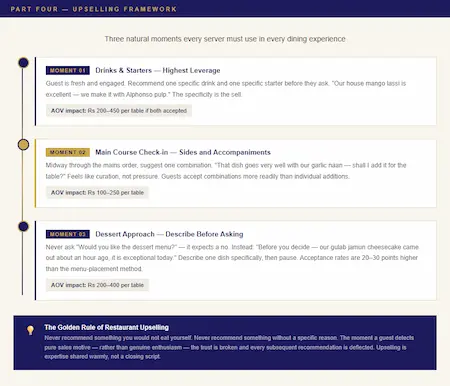
There are three natural, low-resistance moments in every dining experience where an upsell recommendation is appropriate, expected, and welcomed:
Moment One — The Drinks and Starters Order: This is the highest-leverage upselling moment in the meal. The guest is fresh, engaged, and in the early stages of making decisions. A warm, specific beverage recommendation ("Our house mango lassi is excellent — we make it with Alphonso pulp") and a starter suggestion ("Since you're sharing the table, the seekh kebab is our most popular for two people") significantly increases the probability that both a drink and a starter are ordered. Many guests who would never have ordered starters on their own will do so when a trusted server recommends a specific item with specific reasons.
Moment Two — The Main Course Check-in: The mid-meal check is a natural opportunity for side dish or accompaniment recommendations. "The dal makhni is very popular alongside that main — shall I bring a portion for the table?" or "That dish goes very well with our house-made garlic naan." This is not pressure — it is curation. A guest who would have ordered one main and nothing else will often add a bread, a side, or a sharing dish when it is suggested with context and confidence.
Moment Three — The Dessert Approach: The dessert upsell is the moment most restaurants either execute poorly (the apologetic "Would you like to see the dessert menu?" that expects a no) or skip entirely. The high-converting approach is to describe one specific dessert with genuine enthusiasm before placing the menu in front of the guest: "Before you decide — our gulab jamun cheesecake is exceptional today, it came out of the kitchen about an hour ago. It is very good." The description does the selling before the decision is even formally requested. Dessert attachment rates in restaurants that use this approach consistently run 20 to 30 percentage points higher than in restaurants that use the generic menu-placement method.
Cross-selling — Thinking in Combinations, Not Individual Items
Cross-selling — recommending complementary items alongside what a guest has already ordered — is both more natural and more effective than upselling in most dining contexts. Guests do not feel sold to when a knowledgeable server says "That dish goes really well with our house pickle and a garlic kulcha" — they feel guided. The combination feels curated, intentional, and trustworthy.
Train your team to know the three to four best item pairings on your menu and to mention them naturally in the course of service. "The short ribs are wonderful with the truffle mash — most people order them together." "The rasmalai is very light after a heavy meal — just the right way to finish." These are not scripts — they are genuine food knowledge shared in the spirit of hospitality. Teams that know your menu this way become your highest AOV-generating asset.
Part Five: Bundling and Set Menu Strategy — Packaging for Higher Perceived Value
Bundling — the practice of grouping individual items into a set or combo offering at a combined price — is one of the most consistently effective AOV strategies across every restaurant format and price point. The psychological reason is well-established: when items are presented as a bundle, the guest evaluates the combined offering rather than comparing individual item prices. The mental transaction shifts from "am I willing to pay Rs 350 for a starter?" to "is the full lunch experience for Rs 850 a good deal?" And the answer to the second question is almost always yes — partly because the framing is more favourable, and partly because the bundle genuinely represents better value than the sum of its parts priced individually.
Bundling also serves a powerful psychological function beyond price perception: it reduces decision fatigue. A guest who is presented with a well-designed lunch set — starter, main, dessert, and a drink — does not need to make four separate decisions. They make one decision: is this experience worth Rs 850? This ease of decision is particularly valuable for walk-in and lunch-hour traffic, where guests are often time-constrained and appreciate the simplicity of a single, well-curated choice.
Designing Bundles That Maximise AOV
The most common bundling mistake is using the bundle to dispose of slow-moving items by forcing them into a set that otherwise looks attractive. Guests who order a set menu and feel that they were pushed toward dishes they would not have chosen independently are not repeat visitors. The bundle must be genuinely appealing — built around items guests actively want, not items you want to move.
The right approach to bundle design is to start with your Stars and your highest-margin items and build a set that naturally accommodates them. If your Star main is the slow-cooked lamb curry and your highest-margin starter is the seekh kebab platter — build your lunch set around these. The items sell themselves, the bundle makes them feel accessible and complete, and the guest experiences exactly what your restaurant does best. That is the bundle that drives repeat visits alongside high AOV.
The Business Lunch Set — Your Most Reliable AOV Driver
For restaurants operating in commercial, office, or high-footfall locations, a well-designed business lunch set is often the single highest-AOV product on offer. The typical solo lunch guest, ordering a la carte, will order one main and a beverage — AOV of perhaps Rs 400 to Rs 600. The same guest presented with a compelling two-course lunch set at Rs 750 to Rs 900 that includes a starter or dessert and a drink will frequently upgrade. They were always going to spend that hour eating — the set makes spending more feel easy and justified.
The business lunch set works best when it has three clearly designed components: it must feel like good value (not cheap — the framing is "complete, curated, worth it"), it must be time-efficient (communicated clearly as a 45-minute turnaround service for working guests), and it must change weekly or seasonally (creating a reason for the same guest to return every week rather than defaulting to the same nearby option).
Sharing Boards and Table-Centre Dishes — Social Ordering as AOV Strategy
For casual and social dining formats, sharing boards and table-centre dishes are one of the most effective tools for increasing table-level AOV without increasing individual guest spend. When a group of four guests orders individually, each person makes a conservative, independent decision. When the same group is invited to "start with something for the table" — a sharing platter of appetisers, a selection of small plates — the ordering decision becomes collective and social, and the threshold for generosity rises significantly.
A table of four that orders a Rs 650 sharing platter as a pre-meal addition has added Rs 162 to each individual's average spend — but none of them individually experienced that as spending Rs 162 more. They experienced ordering something fun together. The social context of the sharing board removes the individual spending hesitation and replaces it with collective generosity. This is why sharing-format restaurants consistently show higher AOV than individual plating restaurants of comparable price point.
Part Six: Dessert Strategy — The Most Consistently Missed Revenue in Indian Restaurants
Dessert attachment rates in Indian restaurants are among the lowest of any cuisine globally — typically 15 to 25 percent of diners order dessert, compared to 35 to 50 percent in European casual dining formats. There are cultural reasons for this — the perception that a large Indian meal leaves no room for dessert — but the operational reason is far more significant: desserts are almost never actively sold. They are offered apologetically at the end of a meal to guests who are already full, already mentally totalling their bill, and already preparing to leave.
The solution is not to redesign your dessert menu. The solution is to introduce desserts at the right moment — which is not at the end of the meal, but during the middle of it.
The Dessert Pre-sell — Mentioning It When It Can Be Anticipated
The highest-converting dessert recommendation happens at the beginning of the meal or during the main course order — not after. "Before you start, just so you know — our gulab jamun cheesecake is our signature dessert. It is very good if you have any appetite left at the end." This mention, made casually during the early stages of the meal, plants a seed. The guest thinks about it during the meal. By the time the server returns to ask about dessert, the decision has already been half-made. The mention at the end becomes a confirmation, not a cold sell.
This technique — sometimes called the dessert pre-sell — consistently increases dessert attachment rates by 12 to 18 percentage points in our consulting experience. It costs nothing and requires no training beyond teaching the team to mention one specific dessert item during the early stages of service.
Dessert as Theatre — Increasing Order Rate Through Visibility
When other tables can see a spectacular dessert being served — a dramatic presentation, a visible garnish, a tableside element — dessert order rates for nearby tables increase significantly. This is the same principle as the window of intrigue for walk-ins, applied internally. A dessert that draws eyes across the dining room is a live advertisement to every table that has not yet decided.
Identify your most visually striking dessert. Engineer its presentation to be slightly more dramatic than necessary. Train your team to serve it with a small verbal note for the benefit of nearby tables: "This is our baked Alaska — the chef flames it tableside." The theatre is a selling tool, not a gimmick. It consistently moves dessert order rates upward without any additional cost.
Part Seven: Team Training for AOV — Turning Knowledge Into Revenue
Every technique in this guide — menu engineering, pricing psychology, beverage selling, upselling moments, dessert pre-selling — ultimately depends on your team to execute it. A perfectly engineered menu in the hands of a team that neither knows nor cares about its contents will underperform. A well-trained, genuinely engaged team working with a merely adequate menu will consistently outperform on AOV because they are actively and authentically selling the experience.
Team training for AOV is not about teaching scripts. Scripts are detectable, and guests who detect them withdraw. Training for AOV is about building genuine menu knowledge, developing enthusiasm for specific items, and creating a team culture in which recommending dishes well is understood as a form of hospitality — not as a commercial obligation.
The Weekly Tasting Briefing
The single most effective tool for improving team AOV performance is a weekly tasting briefing in which three to four specific dishes — one starter, one or two mains, one dessert — are prepared for the team to taste and discuss before service. Not described. Not shown. Tasted.
A server who has personally tasted the lamb curry and genuinely enjoyed it does not need a script to describe it to a guest. They have a real experience to share. "I had this at our briefing on Monday and it was excellent — the spicing is different from what you might expect, there is a lot of depth" is a description that sells because it is true and personal. This authenticity is the most powerful sales tool available to any restaurant, and it is entirely free to create — it requires only that you feed your team the food before the guests arrive.
AOV Tracking Per Server — Using Data to Build Culture
Individual server AOV tracking — noting the average bill size per server per service — is one of the most effective performance management tools in F&B, and one of the least used. When servers know that their individual AOV is tracked and discussed, those who are selling well take pride in it. Those who are underperforming become visible — and the conversation about how to improve is grounded in data rather than impression.
Implement this carefully and with the right framing. AOV tracking should be presented as a professional development tool, not a surveillance mechanism. "Last week, our table average was Rs 680. Our top-performing server averaged Rs 820 per table. This is not about pressure — it is about understanding what they are doing differently so we can all learn from it." This framing creates curiosity and aspiration rather than anxiety. The improvement in team AOV over four to eight weeks of this practice is consistently significant.
The Pre-service AOV Briefing
Every service briefing should include an AOV component. This does not need to be elaborate — it needs to be consistent. Three elements are sufficient:
-
Today's featured recommendation: One specific dish that every server is briefed to recommend today. Not generically — with a reason. "Recommend the Coastal Prawn Curry today — the chef got exceptional prawns this morning and it will be off the menu after this service."
-
Today's featured beverage: One specific drink recommendation. The house special, a seasonal cocktail, or a wine that pairs with today's featured main.
-
Today's featured dessert: The dessert that every server will mention during the main course order — and the specific language they will use to describe it.
Three items. Two minutes in the briefing. This practice, maintained consistently over weeks, creates a team that is always informed, always enthusiastic about specific items, and always positioned to sell with the specificity that converts.
Part Eight: Measuring AOV — What to Track and How to Act on It
AOV improvement is not a one-time project. It is an ongoing operational discipline that requires consistent measurement, honest review, and targeted action. Without tracking, even the best-intentioned team improvements dissolve over weeks as habits revert and attention moves elsewhere. With tracking, AOV improvements compound — each week's learning builds on the last, and the team develops a genuine culture of revenue awareness that becomes self-sustaining.
The Four AOV Metrics That Matter
-
Overall table AOV by service period: Track average spend per table — not per cover — across each service period: breakfast, lunch, and dinner separately if applicable. Patterns within service periods reveal the most targeted improvement opportunities. A strong dinner AOV but weak lunch AOV points to a specific lunch strategy gap. A weak weekend AOV despite high covers suggests the team is handling volume at the expense of revenue quality.
-
Beverage attachment rate: What percentage of tables ordered at least one non-water, non-included beverage? This is the single most direct measure of your team's beverage selling performance. A rate below 50% in a dinner service context suggests either a beverage programme problem (the drinks are not worth ordering) or a selling behaviour problem (the team is not asking). Both are fixable, but fixing the right one requires knowing which it is.
-
Starter attachment rate: What percentage of tables ordered at least one starter? In Indian restaurants, this rate is often surprisingly low — particularly at lunch — because starters are not being proactively mentioned. A starter attachment rate below 40% at dinner is a strong signal that the three upselling moments are not being consistently executed.
-
Dessert attachment rate: What percentage of tables ordered at least one dessert? As noted earlier, this is the most consistently underperformed metric in Indian F&B. A dessert attachment rate below 25% at dinner is a training problem — specifically, a problem with when and how desserts are being mentioned in the service flow.
Building a Weekly AOV Review Habit
Dedicate ten minutes of one management meeting per week to reviewing these four metrics from the preceding week. Compare to the previous week. Note what changed and why. Identify which server, which shift, or which day showed the strongest performance — and make that a conversation point with the team. "Tuesday dinner had our highest AOV this week — Rs 820 per table. The team that evening did something well. Let us understand what it was."
This practice, maintained consistently, does two things simultaneously: it keeps management focused on the most impactful revenue lever available without additional marketing spend, and it signals to the team that AOV is taken seriously at every level of the business. Teams that know their AOV is tracked and discussed are teams that think about their AOV while they are serving.
Conclusion — AOV Is the Profit Lever You Already Own
Every strategy in this guide — menu engineering, pricing psychology, beverage revenue, upselling moments, bundling, dessert strategy, and team training — operates on guests who are already in your restaurant. Already seated. Already committed to a meal. Already favourably disposed toward spending money on something they are about to enjoy. The only question is whether you are designing the environment, the menu, and the team behaviour to make that spending as high as it can comfortably and authentically be.
The gap between your current AOV and your achievable AOV is not a marketing problem. It is not a footfall problem. It is not a price problem. It is a design and execution problem — in the way your menu is structured, in the way your team talks about food and drink, in the way your pricing is presented, and in the way your service flow is managed. Every one of these things is within your direct control, requires no external spend, and can begin showing results from the very next service.
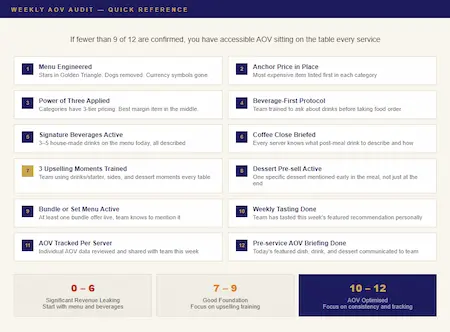
Run the audit checklist honestly. Find your biggest gap. Fix that one thing before moving to the next. In our experience, operators who approach AOV improvement with this disciplined, sequential focus consistently achieve 15 to 25 percent AOV growth within the first 90 days — without adding a single cover, without raising a single price, and without spending a rupee on external marketing. The money was always there. It was in the room. It just needed a system to capture it.
About Zion Hospitality by Chef Ajay Chopra
Zion Hospitality is India's leading F&B consulting practice, led by Chef Ajay Chopra. We have worked on more than 50 restaurant openings, repositionings, concept developments, and operational turnarounds across India, Dubai, and Southeast Asia. Our consulting work covers the full restaurant lifecycle: location strategy, concept and brand identity, menu development and engineering, kitchen design, staff training, AOV optimisation, walk-in footfall strategy, and ongoing operational advisory.
If you would like to speak with our consulting team about your restaurant's average order value, menu engineering, or any aspect of your F&B operations, we would welcome the conversation.
Talk to a Consultant: www.chefajaychopra.com/restaurant-consultant
View Our Projects: www.chefajaychopra.com/restaurant-consultant